
Leather cleaning
The starting point for every restoration. On dirty leather no colour or protector will hold.
More about this serviceŻuławy means damp — and it is damp, not use, that most often ruins leather here in cars and furniture kept in unheated buildings.
Leather stored in damp behaves differently from worn leather: it doesn't wear through, it stiffens and gets covered in a bloom, and in worse cases mould. A piece of furniture from a garage or a car after a winter under a cover can look far worse than its age would suggest.
This is the first step and it can't be skipped: until the surface is clean, no product will bond. With mould we also check what's underneath — if the foam is damp through, the leather alone won't solve it.
Once dried, leather can be as stiff as cardboard. Softening gets it flexing again before it starts cracking at the folds.
A protector reduces moisture absorption, but it won't replace ventilation. We'll tell you plainly what a product can do and what has to change in the way it's stored.
Each of these services has its own page — with a description, the course of work and photos.
The starting point for every restoration. On dirty leather no colour or protector will hold.
More about this serviceLeather exposed to the sun goes stiff — fastest of all in a car. Softening brings back its suppleness before it starts to crack.
More about this serviceProducts that protect against UV, water and denim dye transfer — the most common cause of stains on light-coloured seats.
More about this service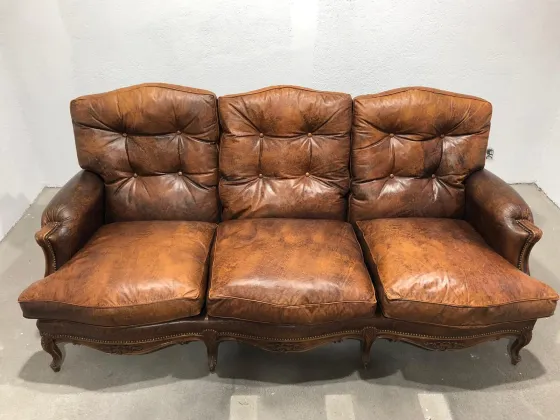
Sagging seat cushions, worn armrests, faded colour. Full cycle: cleaning, leather softening, filling, re-colouring, protection.
More about this serviceIn an unheated garage, a summer house or an outbuilding, leather deteriorates without being used. Moisture gets into the pores, a bloom and mould spots appear on the surface, and once dry the leather hardens and cracks. A piece of furniture or a car can look worn out even though hardly anyone used it.
First cleaning that removes the bloom and spores — without it the spots come back. Then softening the hardened leather, filling the cracks and colouring. Finally impregnation, which limits the absorption of moisture.
If the moisture has passed through the leather into the foam and the frame, restoring the leather alone won't solve the problem. We say so when we quote, before we start anything.
The workshop is in Gdańsk, ul. Litewska 12 — Nowy Dwór Gdański is about 34 km away in a straight line.
Send a photo of the whole thing and a close-up of the damage, or just give us a call. From that we tell you whether it can be saved.
We give you the scope of work and the price. If restoration isn't worth it, we'll say so plainly — it happens, and it's better to hear it before than after.
Cleaning, damage repair, re-colouring, protection. On larger jobs we send you progress photos.
We tell you what to care for the leather with and what damages it fastest. That usually decides whether the result lasts for years.
The quickest way is this: a photo of the whole item, a close-up of the damage and a note on what the item or part is. On that basis we'll tell you whether it can be saved and what it will cost.
We use cookies so that the site works and so that we know which content is useful. Statistics are on by default — under “Customise” you can switch them off and the site will work just the same.
Privacy policy →Required for the site to work at all: remembering your choice in this window and the admin panel session. They cannot be switched off.
nbd_zgody | 1 year | your cookie choice |
nbd_admin | until the browser is closed | admin panel session (staff only) |
nbd_dev | 60 days | remembered admin panel device (staff only) |
They help us understand how visitors use the site — which pages they read and where they come from. Collected anonymously.
_ga | 2 years | Google Analytics — distinguishing users |
_ga_* | 2 years | Google Analytics — session state |